Voltage Drop Calculator
Calculate voltage drop for any circuit using the NEC formula. Check branch (3%) and total system (5%) limits.
Results
What is voltage drop?
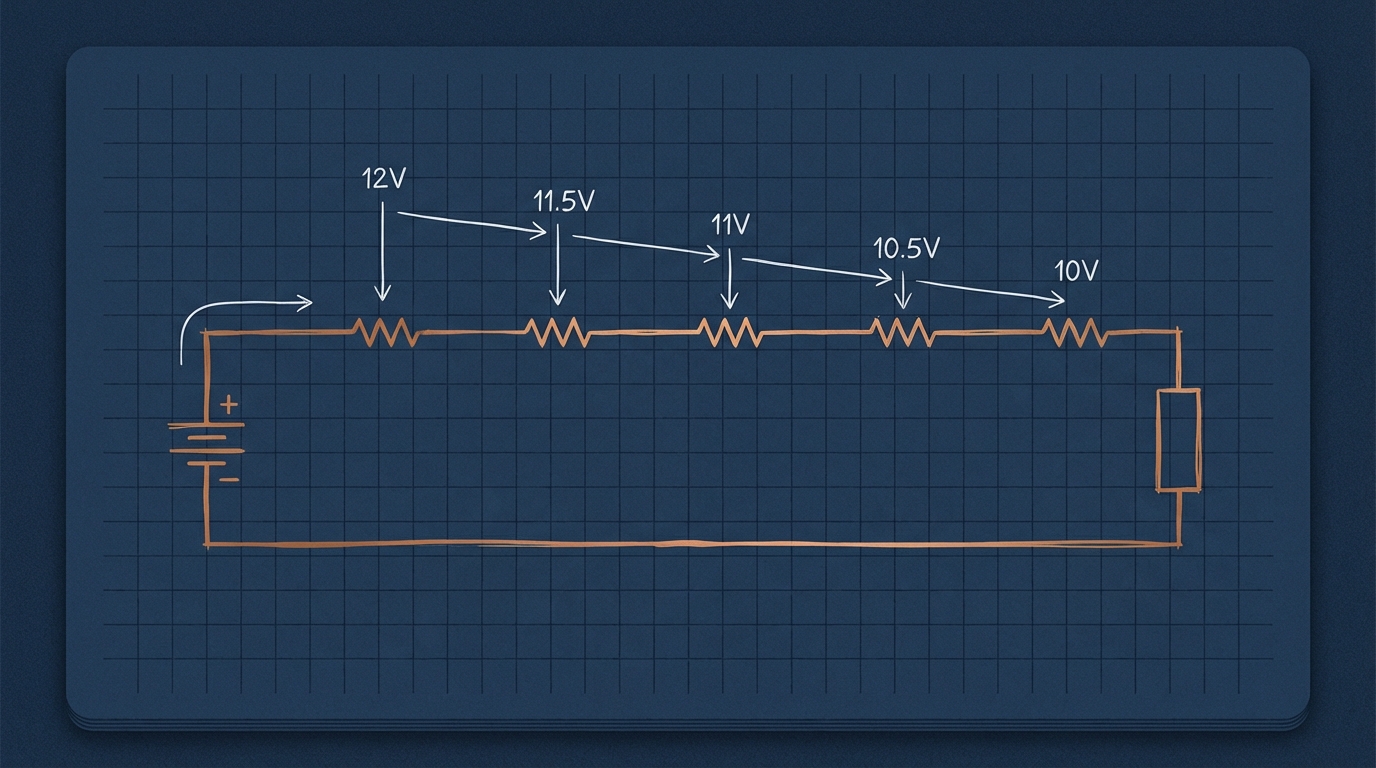
Voltage drop is the decrease in electrical potential along a conductor carrying current. Every wire has resistance, and that resistance converts some electrical energy to heat, reducing the voltage available at the load end of the circuit.
NEC voltage drop limits
The National Electrical Code (NEC) recommends a maximum voltage drop of 3% for branch circuits and 5% for the total system (feeder + branch). While these are recommendations rather than hard code requirements, they represent industry best practice and are enforced by many local jurisdictions.
The voltage drop formula
For single-phase circuits: VD = 2 × K × I × L / CM. For three-phase circuits: VD = √3 × K × I × L / CM. Where K is the resistivity constant (12.9 for copper, 21.2 for aluminum), I is current in amps, L is one-way length in feet, and CM is the wire's circular mil area.
When to worry about voltage drop
Long circuit runs, high-current loads, and smaller wire gauges all increase voltage drop. Common scenarios include site lighting on long feeders, well pumps, outbuildings, and EV charger circuits. If your voltage drop exceeds 3%, consider upsizing the conductor or shortening the run.
Planning a job with long runs?
Create a full estimate with wire costs, labor hours, and markup in Faraday — in minutes, not hours.
Get Started Free